
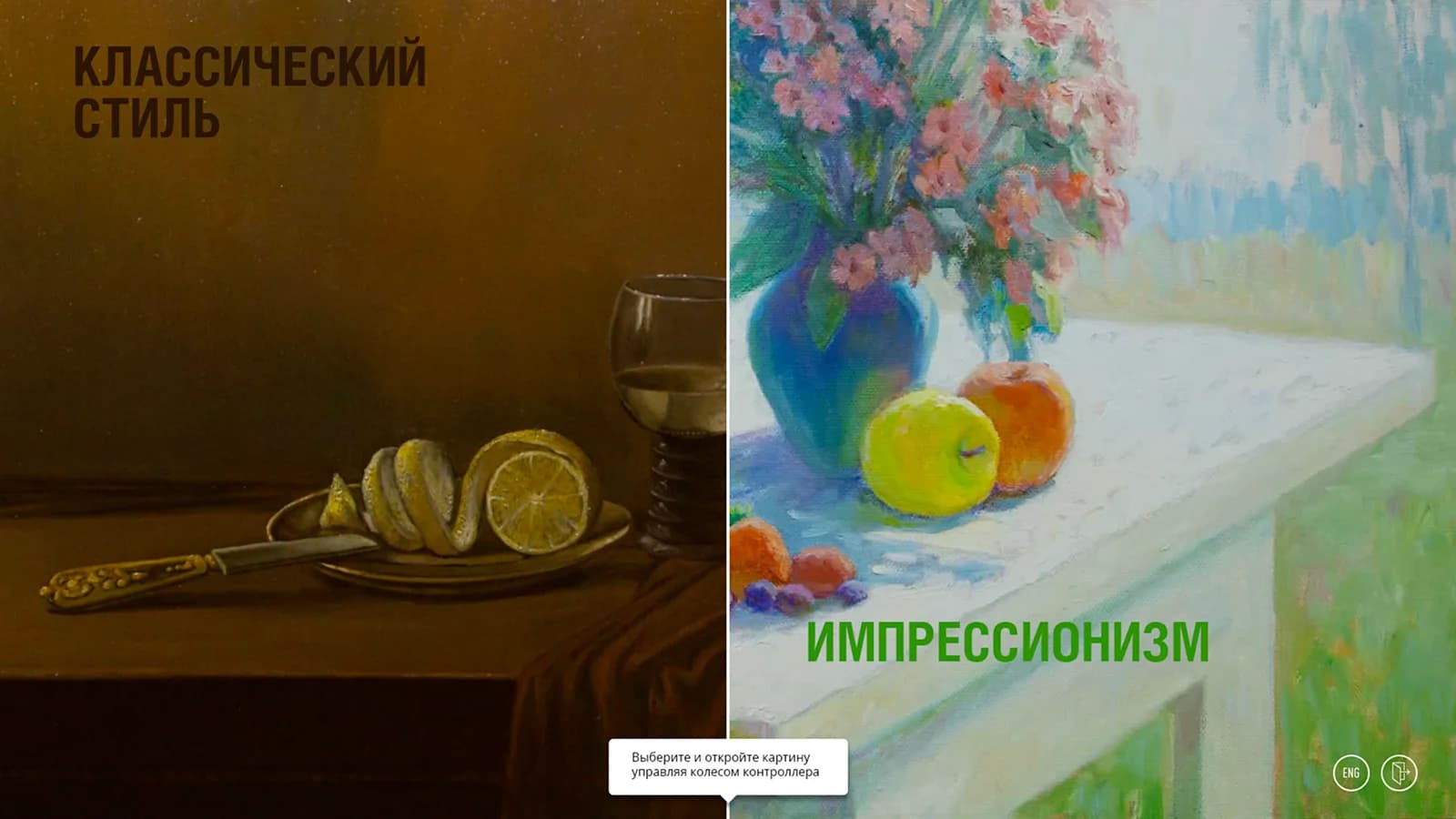
This case is part of the series of interactive installations for the Museum of Russian Impressionism, created for the museum opening in 2016.
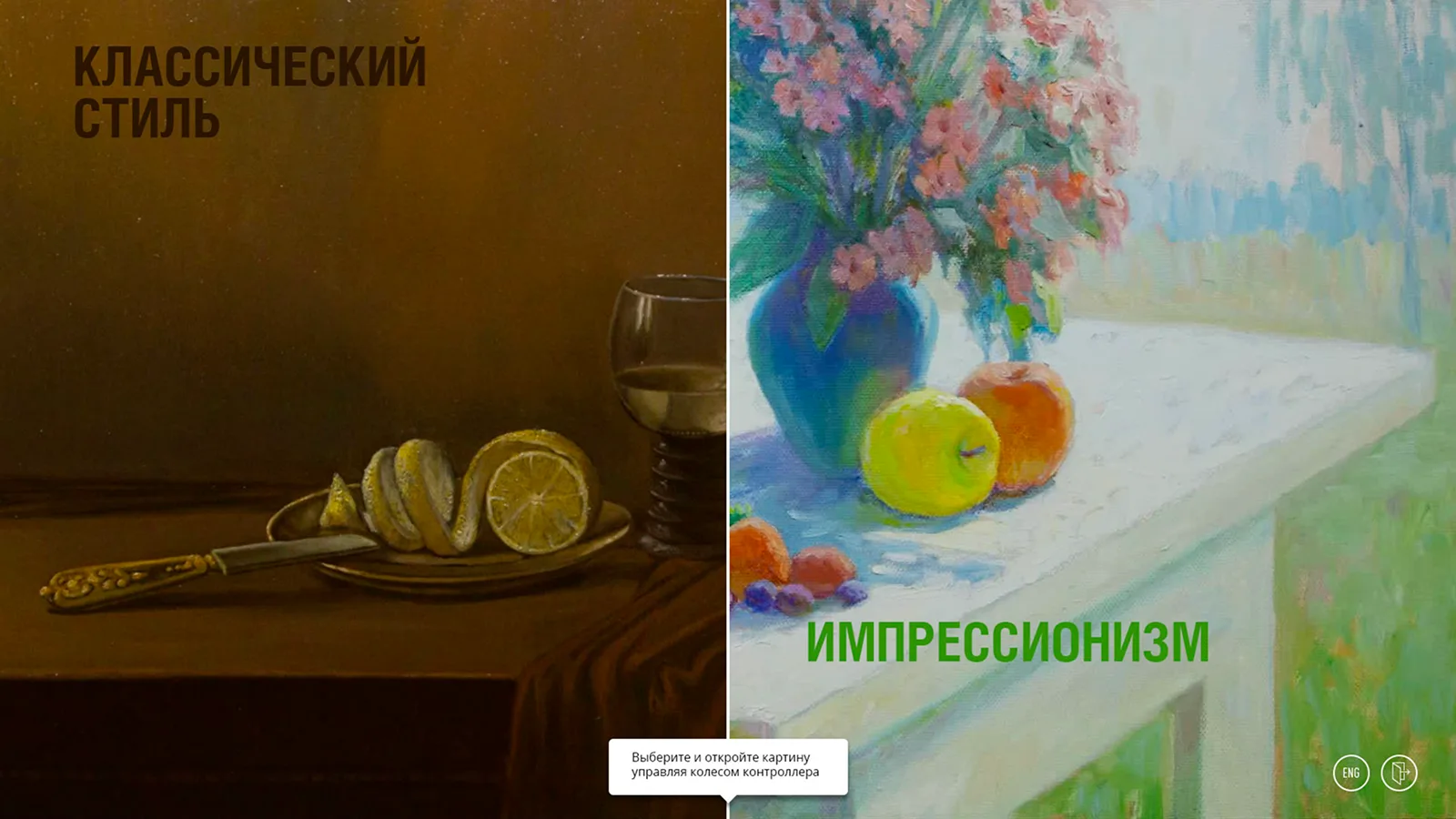
The installation shows how a painting is made step by step and compares academic and impressionist approaches. The visitor sees the process not as a linear video, but as a controlled sequence.
Interaction scenario
The scenario is built around a physical wheel controller. It was already part of the concept, and the interface had to make the control feel natural.
The wheel controls selection and movement through the process. The visitor switches between two paintings and controls the current stage. The interface keeps the connection between the hand, the controller, the current stage, and the image clear.
Design problem
The main question was not how to show more stages. The important part was making the relation between the hand, controller, current stage, and image understandable.
If the visitor does not understand what they are changing, the installation becomes decorative scrolling. The screen had to support looking at the artwork and comparing methods, not compete with the painting.
Interface solution
The screens are organized around the current stage. Hints help the visitor notice how the image changes. Motion connects wheel movement with movement through the process and makes transitions between stages readable.
Takeaway
This installation shows a key museum UX problem: physical action has to be connected to meaning. The wheel, screen, stage, and painting work as one scenario.
Related cases
Back to the series. Related installations: Scientific Experiments: Color and Light, Artist Tools, Artist Workshop Dioramas, Map of Impressionism.