
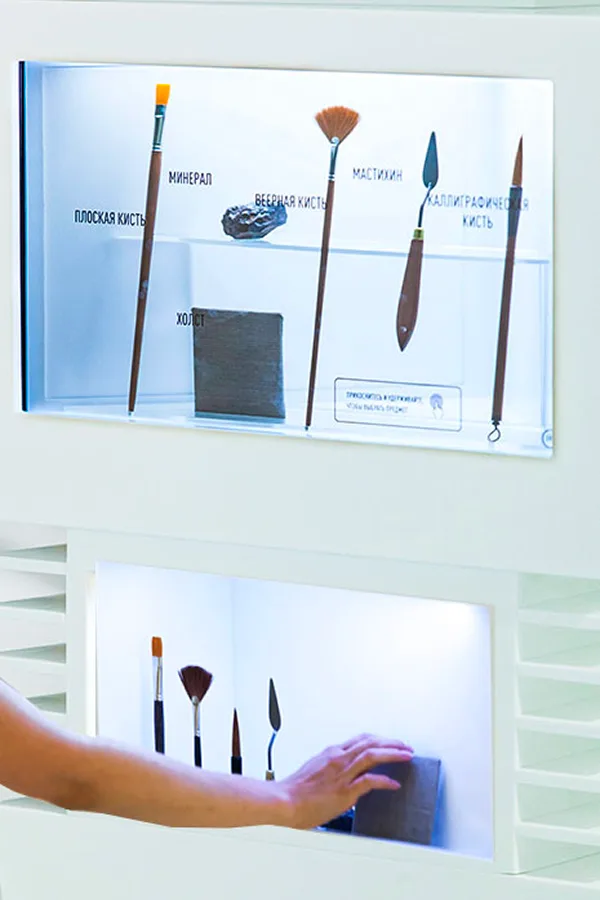
This case is part of the series of interactive installations for the Museum of Russian Impressionism, created for the museum opening in 2016.
The installation is built as a box with a transparent touch screen. Inside are artist tools: canvas, brushes, palette knife, and other objects. The visitor touches an object area and receives an explanation of what it is and how it is used.
Interaction scenario
At first glance, this is the simplest scenario. It is also easy to get wrong. The installation could become a display case with labels, or it could become a clear interactive layer over real objects.
The visitor sees a physical object, touches the matching zone on the screen, and receives an explanation. The screen has to connect object and meaning without taking attention away from the tools.
Design problem
The transparent screen already adds a layer between the visitor and the object. If the graphics become too active, they start covering what they should explain.
The task was precise attachment: highlight, explain, do not block. The real object, touch interaction, and digital comment had to read as one scenario.
Another constraint was height. The project included versions for adults, children, and people with limited mobility, so the interaction logic could not depend on a single comfortable body position in front of the screen.
Takeaway
This installation shows that a museum interface can be almost invisible. Its work is not to replace the object with an explanation, but to give the visitor a short way to look at the real thing more precisely.
Related cases
Back to the series. Related installations: How Paintings Are Made, Scientific Experiments: Color and Light, Artist Workshop Dioramas, Map of Impressionism.