
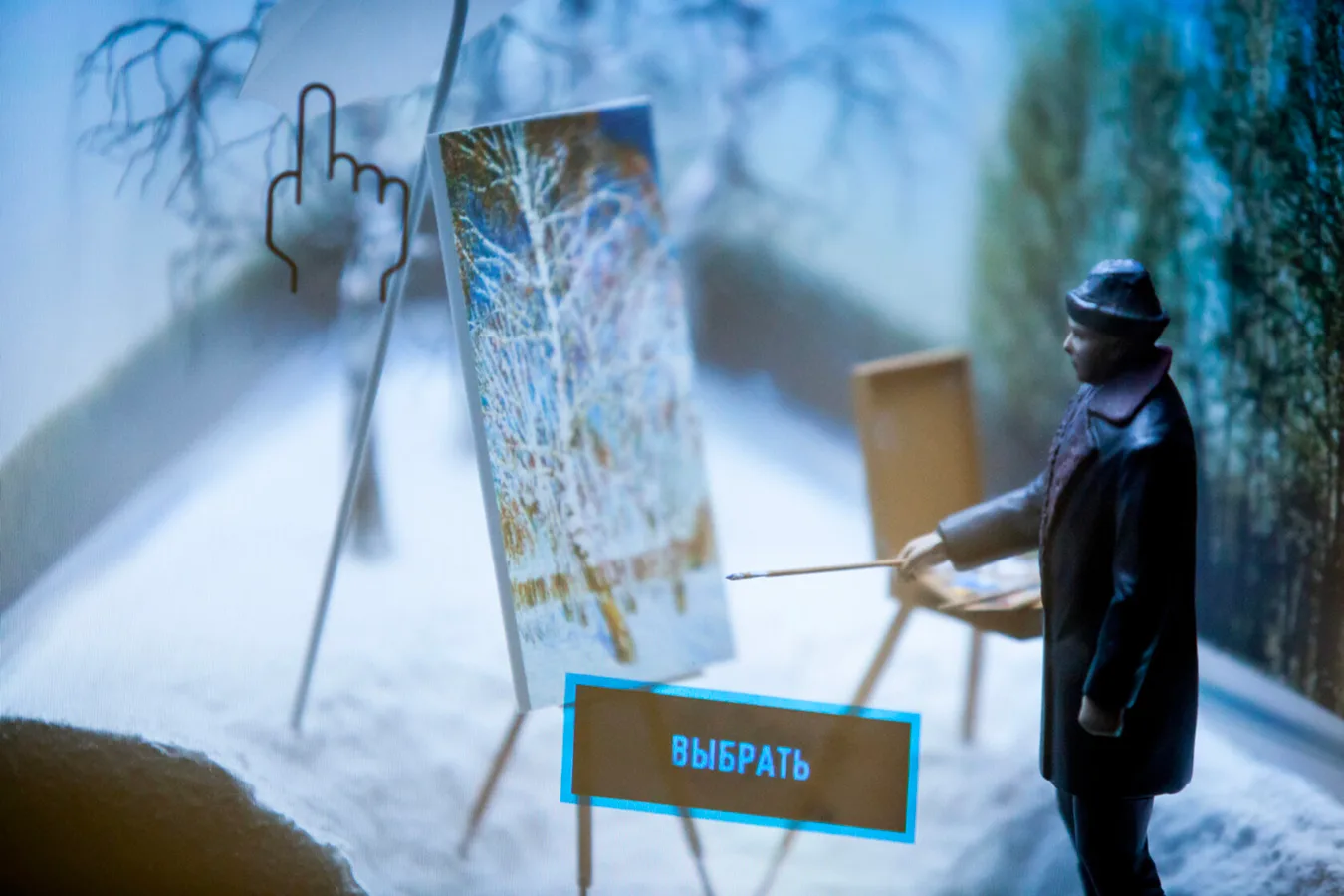
This case is part of the series of interactive installations for the Museum of Russian Impressionism, created for the museum opening in 2016.
The installation shows the difference between working in a studio and painting outdoors. The comparison is built not only through a screen, but also through physical miniature scenes.
Interaction scenario
In one situation, the artist works in studio conditions. In the other, the artist works outdoors. Light, space, color behavior, and the feeling of the environment change.
The interface makes the comparison visible immediately: through composition, switching, and hints that guide attention. The difference between conditions should be readable without a heavy art-history explanation.
Design problem
The main difficulty was not replacing the physical scene with the screen. In this kind of installation, the screen can easily become the main object of attention, even though the meaningful center is the diorama.
The interface had to work as a guiding layer. It shows labels, switches context, presents stories on the opposite screen, and helps visitors look at the scene more carefully. The goal is not to add an effect, but to return attention to the physical miniature.
Takeaway
The diorama works as a museum balance between object and interface. The physical scene holds attention, and the screen provides structure: what to compare, where to look, and why it matters.
Related cases
Back to the series. Related installations: How Paintings Are Made, Scientific Experiments: Color and Light, Artist Tools, Map of Impressionism.